
Inside the Data: Brian Schroy Races to Power Through Wind and Tight Turns at the Bandit Grand Prix

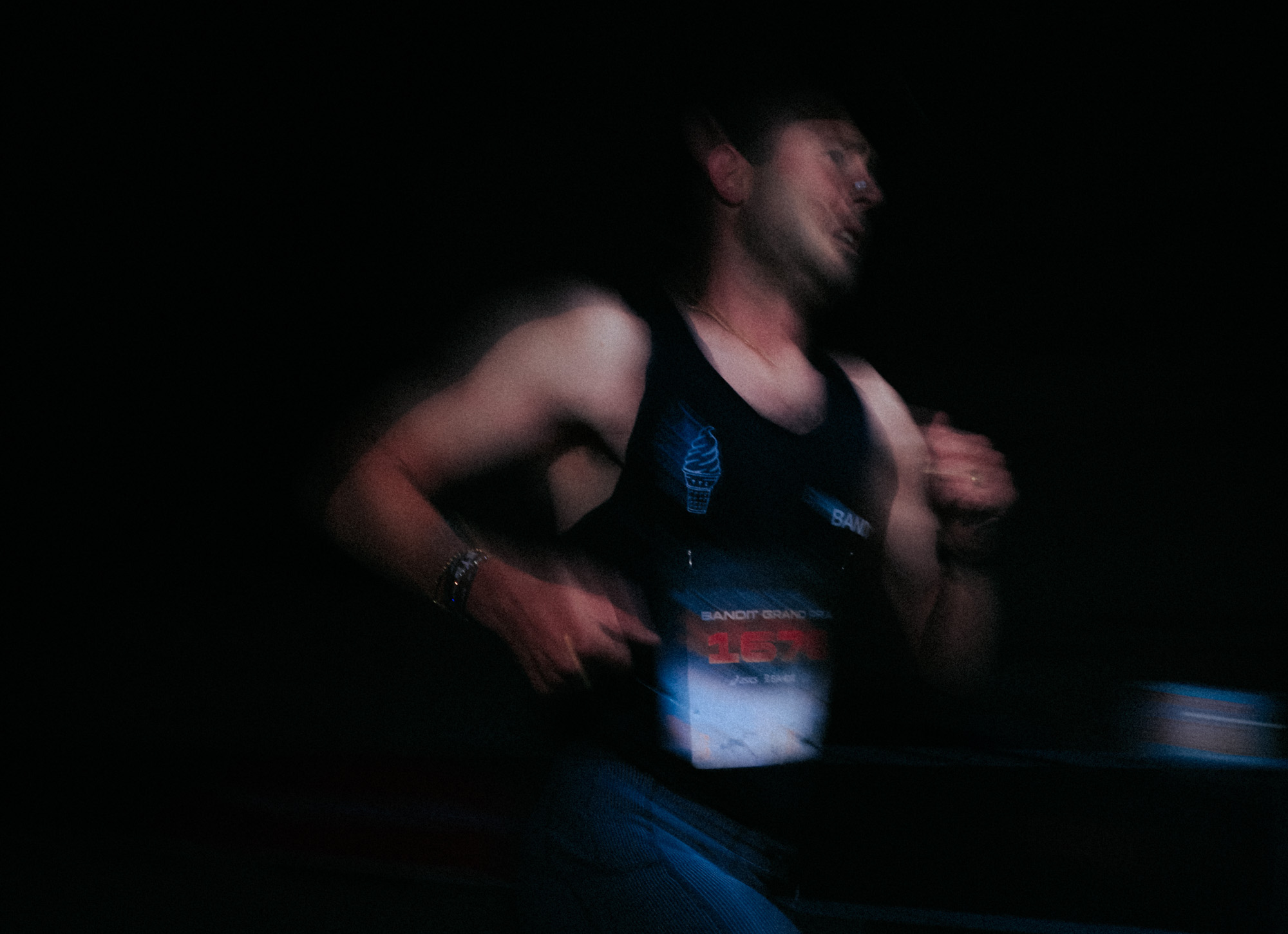
The Bandit Grand Prix is a one-of-a-kind racing event.
Held inside the Brooklyn Storehouse at the Navy Yard in Brooklyn NY, it's a criterium for runners: a tight 1-kilometer loop that weaves between an industrial warehouse interior and the streets outside, packed with spectators, lights, and music, and stitched together by hairpin turns that test the skills of even the best road runners.
Competitors race twice in one day. First comes the 5K Open heat in the morning to qualify. Then, hours later, the top finishers return for the 3K Super Final at night — with the starting grid seeded by where you finished in the Open.
Brian Schroy navigated all of it. In a stacked Open qualifying field, he finished 12th out of 240 competitors in 16:01 at an average of 384 watts in sustained 20 mph+ wind conditions with extreme gusts, comfortably punching his ticket to the Super Final and earning a strong spot on the evening grid.
Then, against a concentrated field of qualifiers, he came back in the 3K Super Final to run 9:25 for 45th out of 165 — at average power of 385 watts, and with his single fastest kilometer of the entire day.
Let's dive into the Stryd data to see how Brian solved the puzzle of the Bandit Grand Prix.
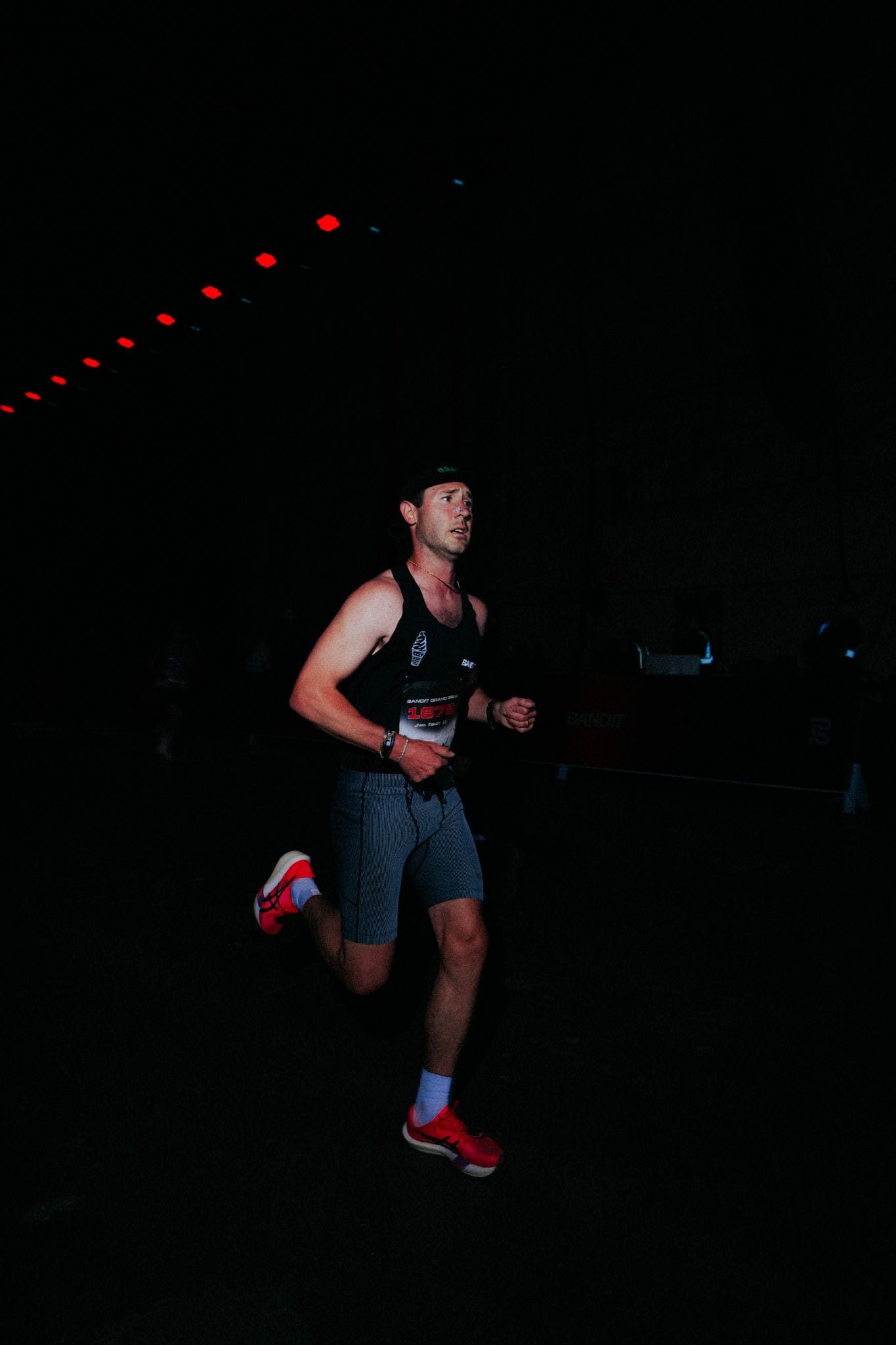
The Two-Race Challenge: Patience Is Key
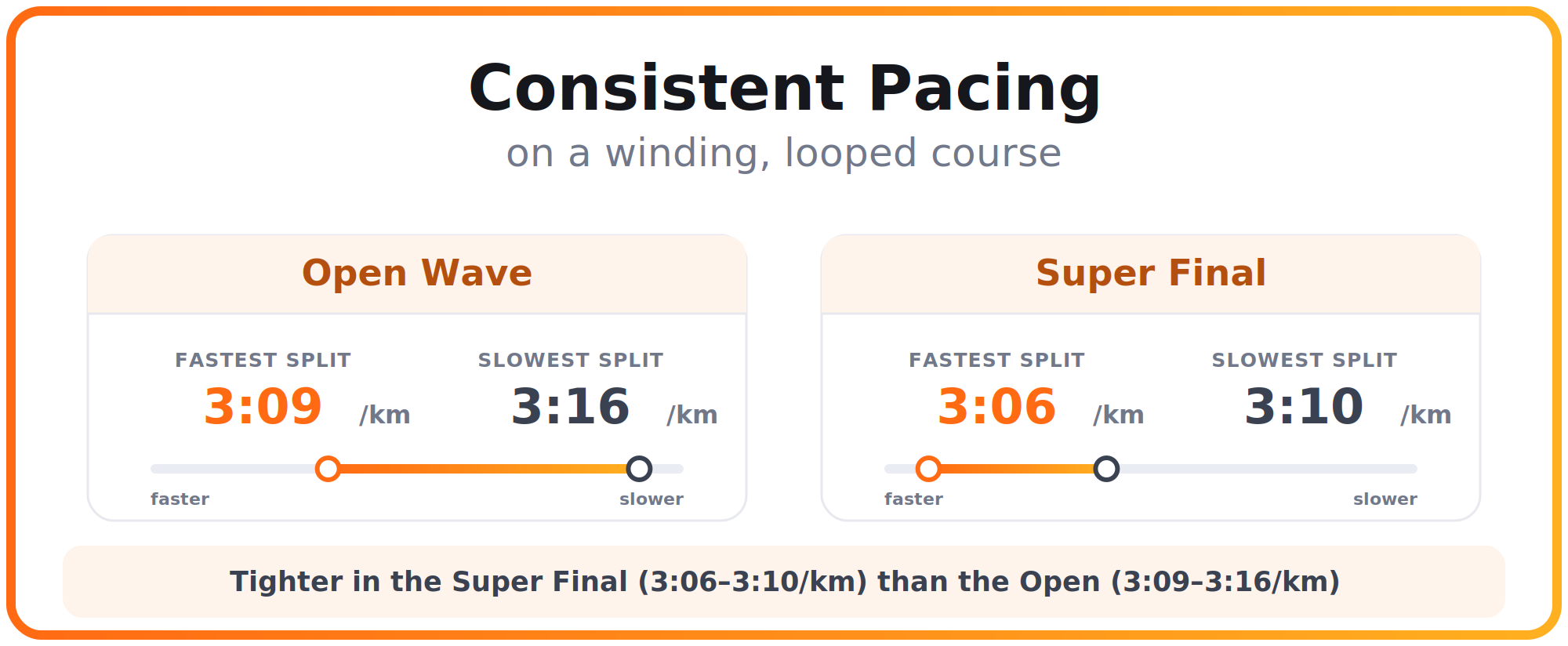
Brian's Open splits tell the story of a runner threading that needle on purpose: 3:09, 3:10, 3:14, 3:16, 3:13. He opened fast to grab position, eased back to hold an even effort through the middle laps, and saved a stronger close for the final kilometer — exactly as he planned it:
"In the qualifier, I tried to go out hot the first lap to put myself in a good position. When I got to the second lap, someone yelled to me and told me I was in 12th. At that point, I realized I could ease off the gas and try to hold an even power for a few laps, then finish with a strong last lap. The wind definitely made for some rougher conditions." — Brian Schroy
He raced hard enough to take 12th in a 240-deep field, but he never tipped over into the kind of effort that would mortgage his evening.
That discipline paid off twice. It secured a favorable Super Final seed, and it left enough in reserve that, roughly seven hours later, Brian could come back and run faster. In a format where the smartest runners are rewarded, patience wasn't a compromise. It was the plan.
Power Succeeds where GPS Struggles
A course that ducks inside a 700-foot warehouse, spits runners back outside, and bends through tight turn after tight turn is just about the worst-case scenario for GPS. Satellites lose the runner indoors, and sharp corners scramble the pace readings that runners normally lean on lap to lap. On a circuit like this, a GPS watch is essentially guessing.
Brian wasn't guessing. Because Stryd tracks motion directly from the body rather than from a satellite signal, his power output stays honest indoors, outdoors, and through every hairpin. That gave him a single, reliable metric to pace against when the GPS-derived numbers were unusable.
Racing in the Wind: Smart Pacing in Every Condition
The conditions added another layer. Wind conditions ran 10–15 mph with gusts spiking to 20–30 mph, and on a looped course that means you meet that wind from every angle, every lap. Stryd captures the effect directly through Air Power — the share of a runner's effort spent overcoming air resistance — so Brian could actually see what the wind was doing to him in real time.
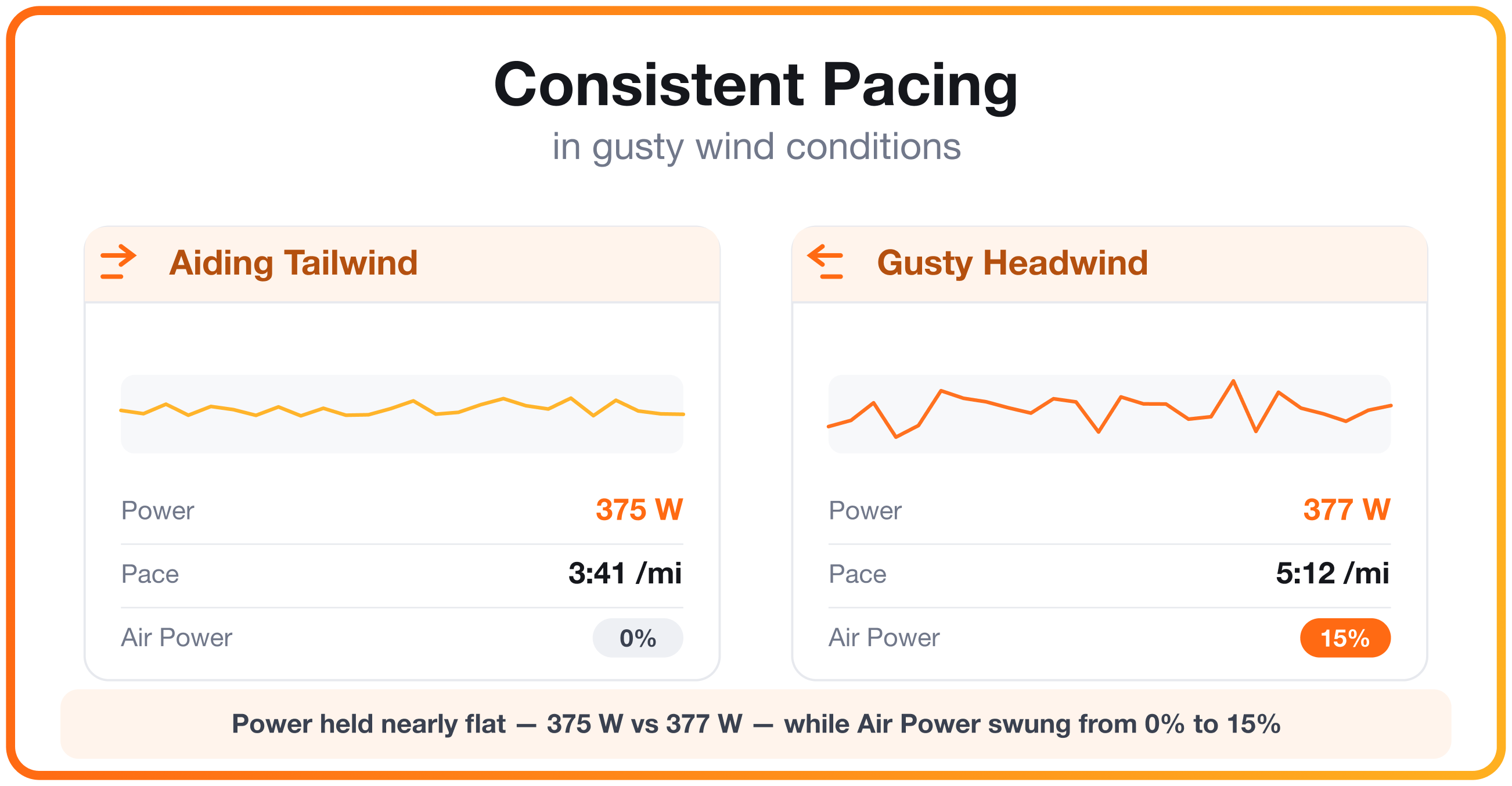
What it showed was a course of extremes. On the tailwind sections, Brian's Air Power dropped to 0% — the wind was aiding his speed — and he touched bursts of speed at sub-4-minute-mile pace. Then, on the exposed straightaways into the wind, his Air Power climbed past 15%, meaning a meaningful chunk of his effort was going purely into fighting the air rather than moving forward.
Here's the masterclass: despite Air Power swinging from nothing to 15%-plus within a single loop, Brian's splits barely budged. He kept his pacing remarkably even — exactly the behavior that wins races where the wind never stops changing.
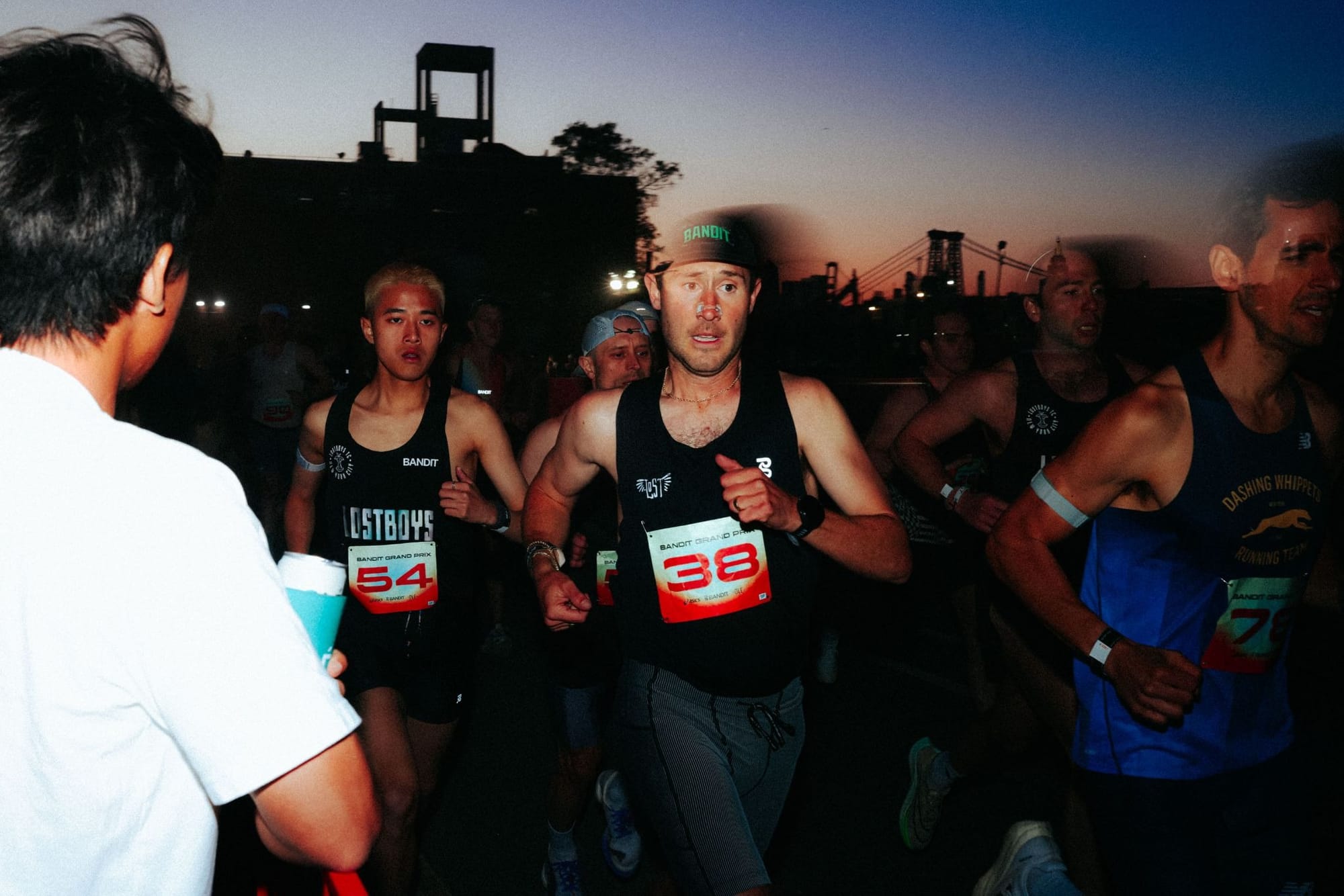
The Super Final brought a different test. The evening wind eased, but with the field now packed with qualifiers, congestion replaced gusts as the obstacle — and Brian leaned on the same even-power discipline to navigate it:
"In the final, the wind dropped but the packs formed. It was very hard to get around people, so I tried to hold fairly even power and pass people whenever I had the opportunity, without too many power spikes. Then the last lap was all about closing hard." — Brian Schroy
Holding steady power while picking his way through traffic, then emptying the tank on the final lap, is the same patience-first approach that carried him through the windy morning, applied to a brand-new problem.
The Power of Data-Driven Racing
Brian Schroy's Bandit Grand Prix reinforces a few principles that apply to runners at every level:
1. Race to power — especially when GPS struggles. On an indoor-outdoor loop with tight turns and shifting wind, a satellite-based pace number was unreliable. Brian's Stryd power gave him one honest metric to pace against, and it held his splits to a steady range across two separate races.
2. Patience wins multi-round formats. The Bandit Grand Prix rewards the runner who can advance and come back stronger. Brian paced the Open to qualify and seed well without emptying the tank, then ran faster hours later. Smart racing was rewarded.
Brian's pacing mastery speaks to the experience he's accumulated as a road racer: the ability to run well across distances and conditions, to stay composed when the wind and the course are working against him, and to know exactly how hard he can push and when.
For runners everywhere, Brian’s day is a blueprint: when the conditions are chaotic and the course won't cooperate, trust the effort you can measure, pace with patience, and let the clock take care of itself.
Follow Brian Schroy’s running journey at https://www.instagram.com/schroy/.