
Using Stryd Duo Data As A Fatigue Signal

Today’s post is brought to you by performance coach Jonah Rosner, who breaks down how he uses Stryd Duo to spot asymmetries before they turn into bigger problems.
But that’s not all—Jonah is also offering a FREE Calf Gym Plan to improve durability, balance, and single-leg capacity.
👉 Download it here: Calf Gym Plan
Nineteen miles into a Saturday marathon workout: a progression run with three tempo blocks built in. Same pace I always run. Same power targets. My watch said everything was on track.
Around mile 4, the Stryd Duo data started telling a different story.
During the warmup, my left and the right sides split the workload evenly. The moment I dropped into a 6:23-6:59/mi pace, the balance shifted.
LSS Balance climbed to 52-53% on the left side. Tempo block two at mile 9? Same shift. Tempo block three at mile 13? Same shift again.
Three tempo blocks. Three identical changes in load distribution. My legs were no longer sharing the load equally under tempo effort.
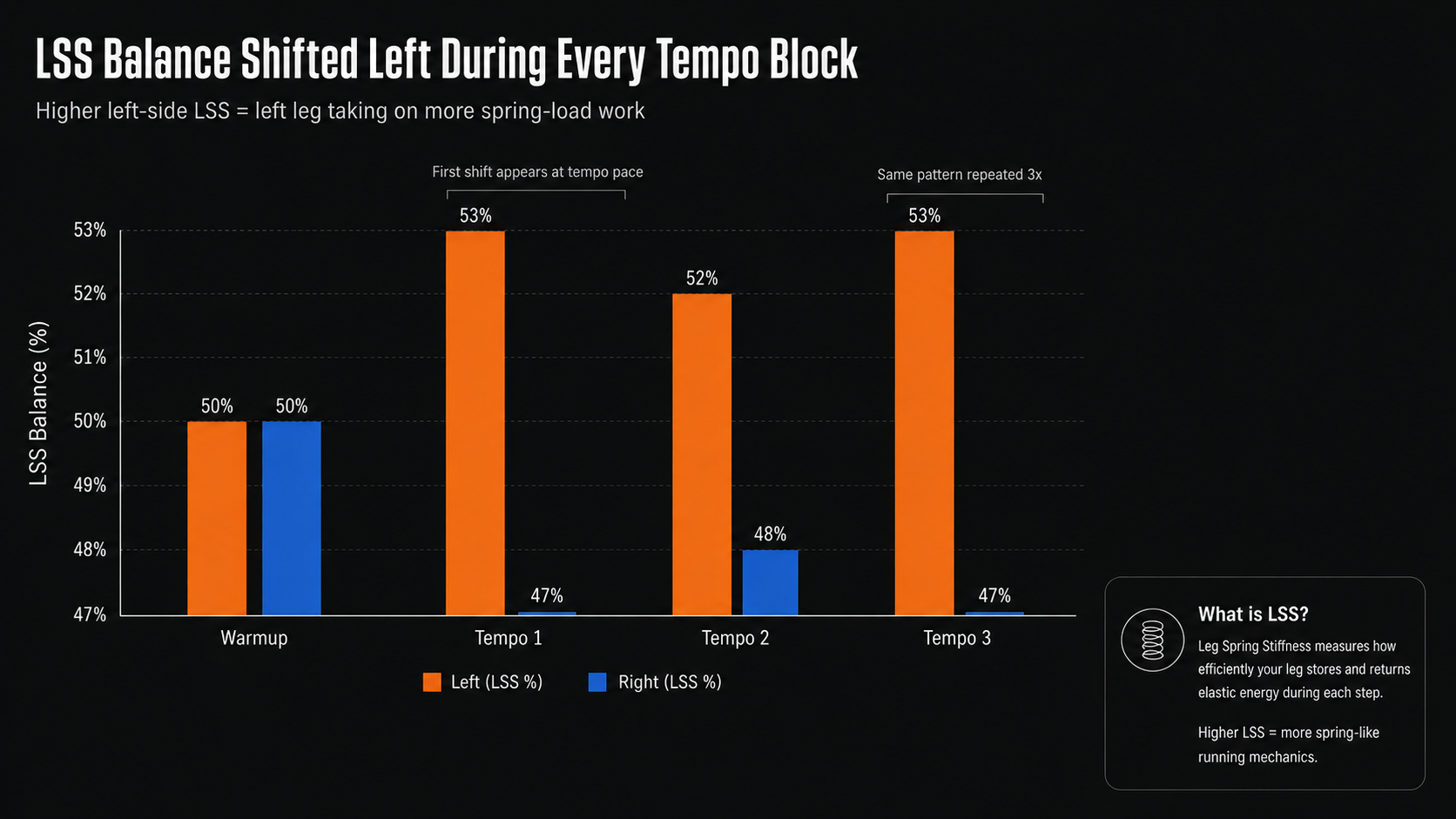
Stryd Duo shows how the workload is distributed between your left and right legs, which is what made this imbalance visible to me in the first place.
So what does the data mean?
A few possibilities are on the table:
- Real fatigue hitting one side harder than the other.
- My right leg offloading work to my left because of a hip niggle I’ve been dealing with.
- Or simply normal day-to-day variation within my typical range.
That’s the challenge with any fatigue signal: context matters.
The value isn’t in one isolated run. It’s in knowing what’s normal for you.
That’s why I like tracking Stryd Duo data consistently across weeks of training. The longer the baseline, the easier it becomes to spot when something truly changes.
Asymmetry Isn't Always a Problem to Fix
Perfect symmetry in running is often a myth.
Every runner has some baseline difference between legs: strength, range of motion, old injuries, even a dominant side for landing or push-off. A 50/50 split isn't always attainable, and chasing it might not even be the goal.
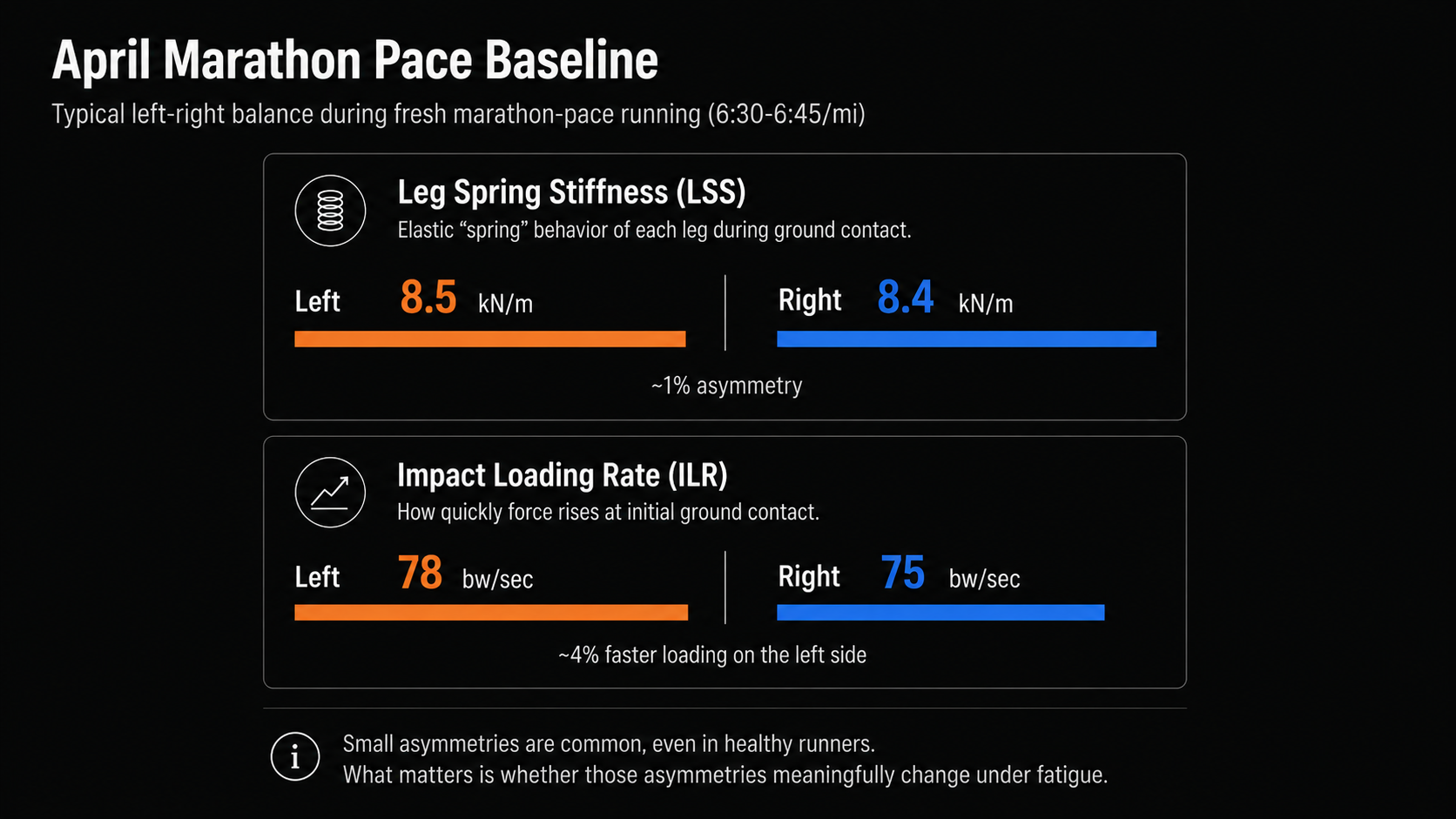
My April baseline shows that. At marathon pace (6:30-6:45/mi), my LSS asymmetry sits within 1% side-to-side (L 8.5 / R 8.4 kN/m).
My loading rate runs about 4% faster on the left at initial ground contact (ILR: L 78 / R 75 bw/sec).
That is my normal. Not a flaw. Just how my legs share the work when fresh.
Research on left-right asymmetry in running is genuinely mixed. Under fatigue, some parts of your gait become more asymmetric while other parts become more even (Radzak et al., 2017).
The direction of change isn't inherently good or bad.
For me, what matters is how my baseline shifts under the stress of a hard or long run.
Fatigue Shifts Up the Leg. One Side Usually Fades First.
Running fatigue doesn't always hit your legs evenly. As a long run goes on, the work can shift upward as your lower legs accumulate stress.
From the ankles toward the knees and hips. Biomechanists call this a distal-to-proximal shift (Sanno et al., 2018).
Runners usually describe it as feeling upright or disconnected late in a run. When that shift is symmetric, both legs move through it together. When it is not, one leg gets there first.
Stryd Duo's balance metrics can help catch the asymmetric version. I like looking at three metrics here:
Ground Contact Time Balance compares how long each foot spends on the ground. One side staying longer can point to decreases in propulsion or stability.
Leg Spring Stiffness Balance compares the elasticity of each leg during ground contact. A sudden drop on one side can signal changes in fatigue, elastic return, or force production.
Impact Loading Rate Balance compares how quickly impact forces rise on each side at initial contact. A widening imbalance signals one side is experiencing a faster rate of loading which may reflect a change in footstrike.
Together, they tell me where my asymmetry is changing.
Three Checks Turn a Signal Into a Hypothesis
Asymmetry data alone helps raise a question. To get to something useful, I cross-check three things.
The Duo data. Which balance metric shifted, by how much, and when in the run. This is the hard data.
How the legs actually feel. The sense of your own body that Stryd Duo can't measure. Which leg feels heavier, which stride feels off, whether it matches something familiar.
Training context. Recent niggles. Where I am in a strength block. Any load spike in the past two weeks. History narrows the possibilities.
When two or three of these line up, I have a hypothesis worth testing. One alone isn't enough.
Back to the March 29 workout. Three possibilities: real fatigue on the left leg, right-hip compensation, or random variation within my normal range.
I can rule out random variation. Left LSS Balance peaked at 52-53% in every single tempo block. The pattern repeated three times across the same workout.
And it wasn't just LSS. GCT shifted at the same time. My right foot started spending longer on the ground (49L / 51R) every time pace picked up. Several metrics telling the same story usually are not noise.
And it tracks with my baseline direction. At marathon pace, my left side already loads slightly faster than right. But under tempo effort, the gap widened beyond my typical marathon pace asymmetry.
The GCT shift to 49L / 51R doesn't show up in my baseline at all. An old asymmetry getting stronger plus a new one appearing. That combination makes it a signal worth acting on, not just normal variation.
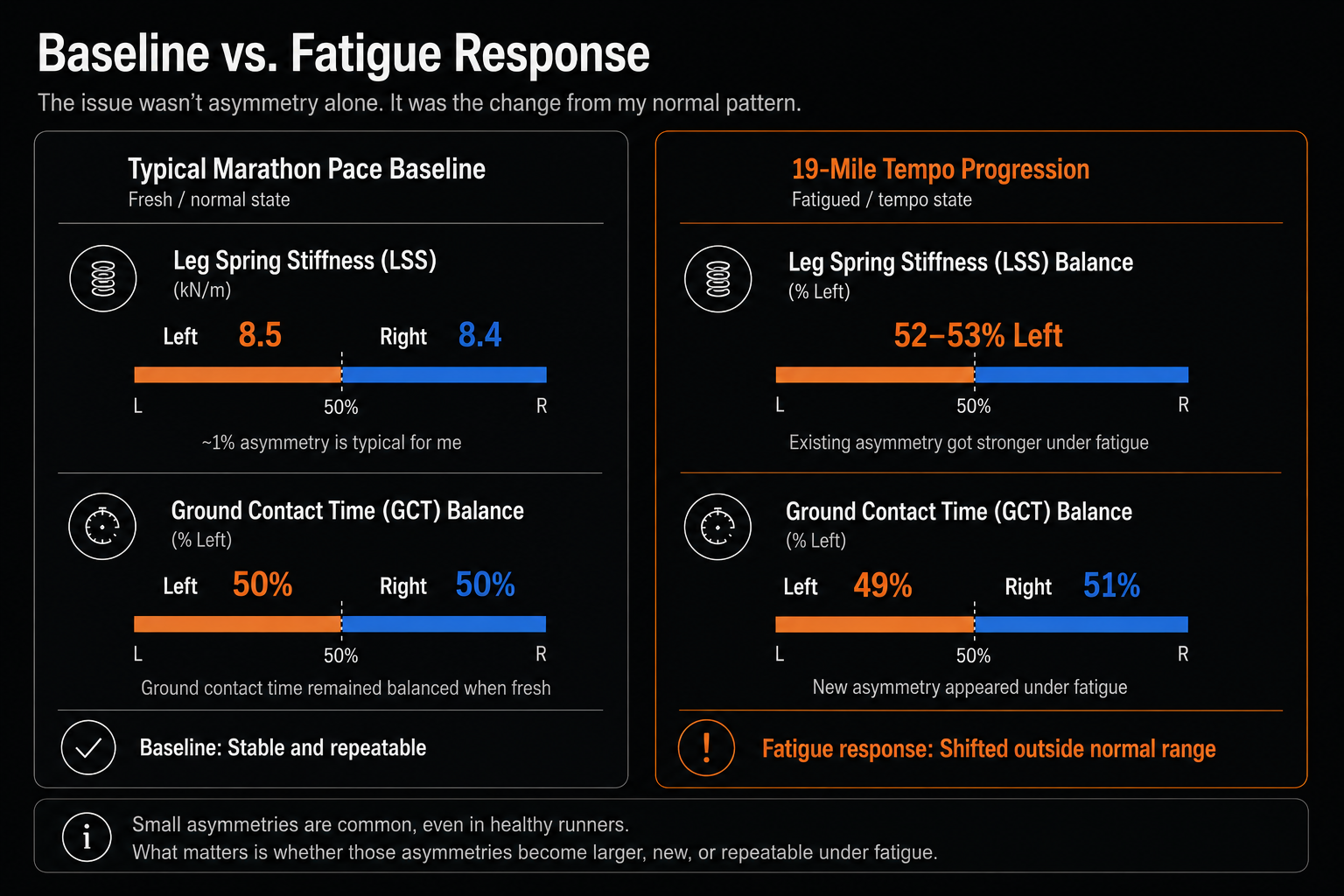
That leaves real fatigue or right-hip compensation. The Stryd Duo data showed Left LSS Balance climbing during every tempo block. My right hip felt tight and a little painful by the end. Training context said I'd been managing a right hip niggle for weeks.
Two of the three points toward compensation from the right: the data pattern and the training context. The subjective pain signal helped confirm it.
What to Do With This
Reading asymmetry data well takes time. Here's how I approach it, one run at a time.
1. Build your personal baseline. Run four to five weeks with Stryd Duo and note your typical balance numbers at easy paces and your workout paces. Without that reference across efforts, it’s hard to tell when a run falls outside your normal range.
2. Find your durability edge. Watch GCT Balance, LSS Balance, and ILR Balance across long runs and workouts. Note when any of those metrics start drifting past your typical range.
Mine showed up during every tempo block in that 19-miler. Yours will likely look different.
3. Cross-check. If the Stryd Duo data shifts outside your norm, compare it against how your legs feel and your recent training load. When two or three signals agree, you can start forming a useful hypothesis.
4. Track across weeks. After a strength block, does GCT Balance stay steadier deeper into your long run than before? Single data points can be outliers. Trends across four to six efforts rarely are.
5. Use the data to audit, not to diagnose. The Stryd Duo numbers are honest. Your interpretation should come from multiple runs, training context, and your own understanding of your body.
After that 19-miler, the data confirmed what my legs were already telling me. Tight. Slightly painful. Borderline broken down.
I had a quality session scheduled for the following Tuesday. I swapped it for an easy bike ride instead and gave the right side space to bounce back.
Not corrective. Protective. Triangulation turned a balance shift into a training-week decision.

Free download for the Stryd community
You just saw three Stryd Duo Balance Metrics (GCT, LSS, & ILR) Asymmetric single-leg capacity is one reason a durability edge shows up early in a long run. The Calf Gym Strength Plan builds the symmetric capacity that keeps those balance numbers steady deeper into your runs.
👉 Download it here: Calf Gym Plan
Sources
Sanno, M., Willwacher, S., Epro, G., & Brüggemann, G.-P. (2018). Positive Work Contribution Shifts From Distal to Proximal Joints During a Prolonged Run. Medicine & Science in Sports & Exercise, 50(12), 2507-2517.
Radzak, K. N., Putnam, A. M., Tamura, K., Hetzler, R. K., & Stickley, C. D. (2017). Asymmetry between lower limbs during rested and fatigued state running gait in healthy individuals. Gait & Posture, 51, 268-274.
Stryd Help Center: Ground Contact Time, Leg Spring Stiffness, Impact Loading Rate metric definitions and the Duo per-leg Balance view in PowerCenter.
Jonah's personal Stryd Duo training data: April 2026 monthly baseline at marathon pace (6:30-6:45/mi); 19.3-mile marathon-pace progression long run, March 29, 2026.