
Dakotah Popehn Runs 2:24:04 at Boston, Delivering a Breakthrough Performance in One of the Fastest Boston Marathons Ever

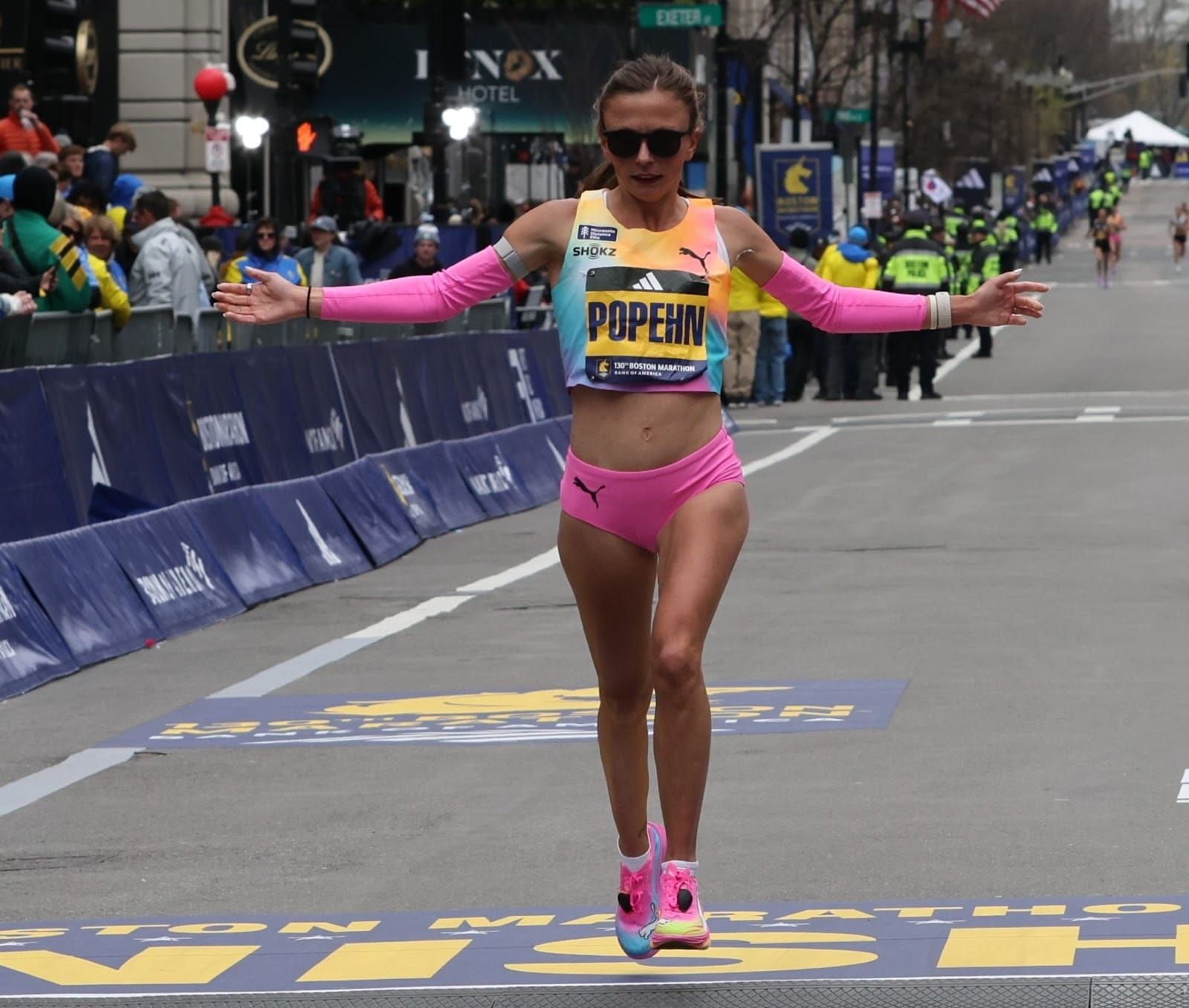
Dakotah Popehn’s 12th place finish at the 2026 Boston Marathon was not just a personal best. It was a clear step forward in execution, efficiency, and durability on one of the sport’s most demanding courses.
Boston rewards patience and punishes early mistakes. In 2025, Dakotah laid the groundwork. In 2026, the work paid off. With improved pacing discipline, more efficient mechanics, years of accumulated work translated into the race she had been building toward.
This was not just a faster race. It was a more complete one.
Let’s dive into the data to see why.
Better Conditions, Greater Durability: A Career Best
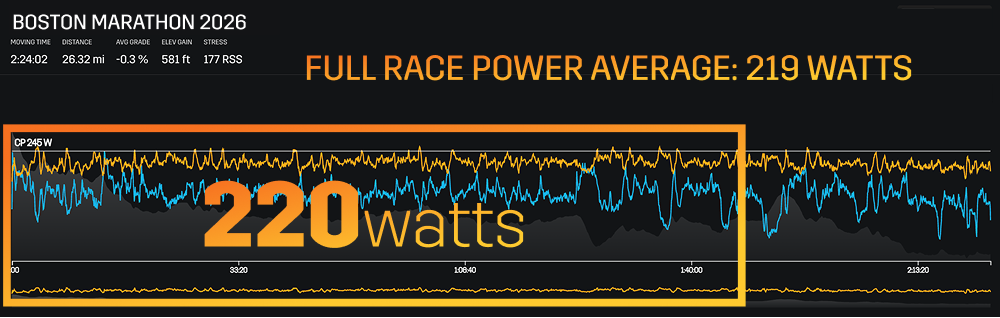
The favorable conditions at Boston 2026 helped, but they do not explain a performance like this on their own. What set this race apart from Dakotah’s 2025 Boston was how she managed her effort from the start—and, more importantly, how long she could sustain it.
Her power output was 3.5% lower than in 2025, which is expected given the tailwind and cool temperatures that allow faster running at a lower physiological cost. The real story is her durability. Through the first three quarters of the race, Dakotah held within 1% of her average power, a level of consistency that is difficult to maintain over 20 miles of rolling terrain. Only in the final quarter did her output dip by 2%, the natural fade that comes at the end of a hard marathon.
Compare that to 2025, where she was already 2.5% down in the third quarter and 3.5% down in the fourth. That is the difference between a race that holds together and one that gradually unravels. In 2026, she stayed durable, composed, and in control.
The Shoe Story Hidden in the Data
One of the more interesting findings in Dakotah’s data goes beyond fitness alone. It may also reflect a change in footwear. She raced Boston 2026 in the Puma Deviate NITRO Elite 4, switching from the Puma Fast-R NITRO Elite 3 in 2025. The biomechanical shifts are clear.
Across key mechanical metrics, there were measurable improvements: a 12% increase in leg spring stiffness, a 10% decrease in impact loading rate, a 2% decrease in ground contact time, a 1% improvement in vertical ratio, and 1 watt less form power. Her mechanical balance remained consistent, suggesting these changes were system-wide rather than isolated to one side.
These changes cannot be attributed to a single factor, but this kind of across-the-board improvement is often influenced by a combination of fitness, health, and equipment. What the data shows is a more efficient system, with more elastic return, less impact, quicker ground contact, and less wasted motion.
Over the course of a marathon, those small gains compound. They reduce the cost of each step and help preserve energy deeper into the race, which ultimately shows up in performance.
Balance Insights: Stability Under Fatigue
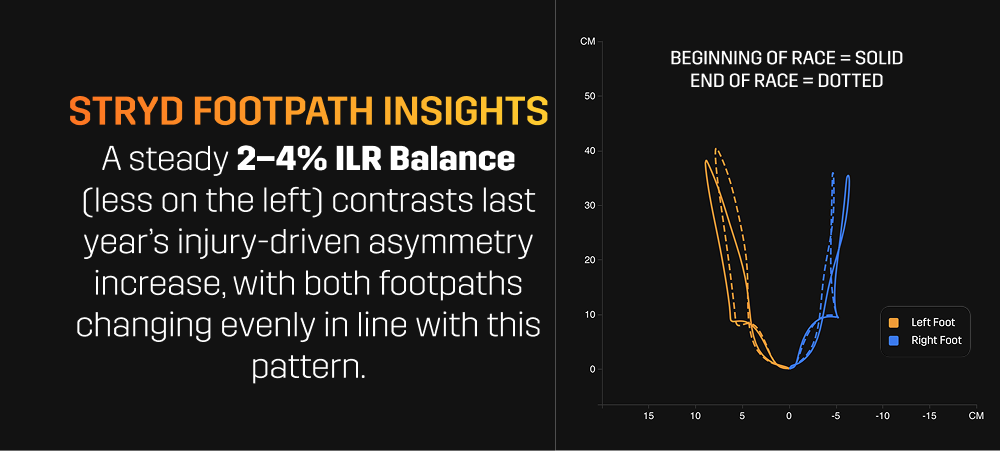
In 2025, Dakotah’s race reflected an athlete managing an injury. As fatigue set in, asymmetry between her left and right sides increased, a clear sign of compensation.
In 2026, that context changed. For the first time in four years, she raced without Achilles pain, and her data reflects it.
Her Impact Loading Rate balance showed a 2 to 4% difference between sides, slightly favoring the left, but it remained steady from start to finish. There was no progressive drift or late-race breakdown.
Both sides adapted similarly as fatigue set in, pointing to a system working together rather than compensating. The asymmetry did not disappear, but it stayed controlled and within her normal range.
That level of stability under fatigue is what allows pacing, efficiency, and fitness to fully translate into performance on race day.
The Power of Data-Driven Racing
Dakotah’s 2026 Boston Marathon performance reinforces several key principles that benefit runners at all levels:
1. Race to power, not pace: Dakotah ran faster without increasing effort. By staying within her power targets, she allowed favorable conditions to translate into performance instead of forcing it.
2. Pacing discipline preserves performance: Holding within 1% of target power through most of the race kept her controlled deep into the later miles and prevented the early fade seen in previous years.
3. Efficiency and stability under fatigue drive results: Improvements in running economy, combined with consistent biomechanics from start to finish, allowed her to maintain form and performance across all 26.2 miles.
Dakotah’s Boston performance is a clear example of how execution, efficiency, and fitness come together on race day.
For runners everywhere, this race highlights how understanding effort through power and tracking biomechanics can lead to smarter pacing, better efficiency, and more consistent results.
As Dakotah continues to build on this foundation, each race adds another layer of insight. The trajectory is clear, and the next chapter is already taking shape.