
Stay in the Moment with Stryd 5.0: Improved Pacing Accuracy & Responsiveness

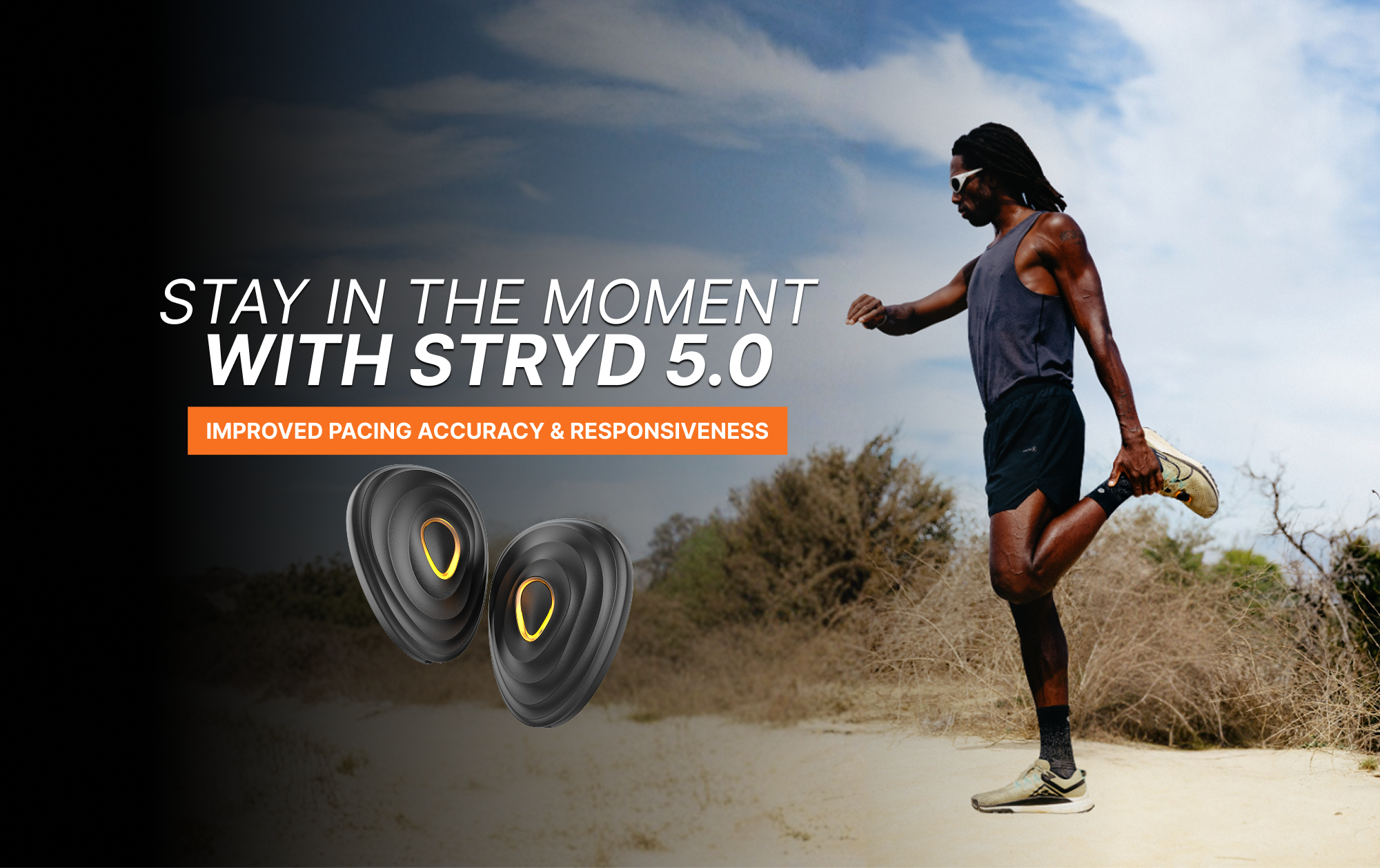
With all-new sensors and refined algorithms, the new Stryd 5.0 doubles down on what matters most: accurate, real time pacing with every step.
It’s built to:
- Hit your target sooner – Responds 2x faster to changes in effort and terrain, so what’s on your watch matches what your legs are doing right now, not a few seconds ago.
- Stay there – Delivers more accurate, stable power, pace, and distance across grades, surfaces, and conditions.
Why pacing accuracy matters
Every runner has felt the cost of bad pacing:
- Starting a workout or race too fast and feeling it long before the finish.
- Letting a hill or headwind crank up your effort while your watch still insists you’re “on pace.”
- Trying to run steady but getting yanked around by jumpy GPS in cities, under trees, or on the track.
Accurate pacing is about more than having the correct number on your wrist; it shapes:
- Better workouts – Hitting the right training zones instead of adding unfocused fatigue.
- Better races – Holding a sustainable, intelligent effort instead of overreaching early and fading late.
- Better training over time – Keeping your cumulative stress smooth and predictable instead of spiking toward burnout.
Why pacing responsiveness matters
Accuracy alone isn’t enough. If your power or pace eventually converges to the right value but takes too long to get there, you’re still guessing in the moments that matter most:
- The first part of an interval or during an in-race surge.
- When you hit an uphill ramp or crest a hill.
- The switch from flat to technical trail or from sidewalk to grass.
Heart rate is a classic example: it’s always catching up to your effort instead of reflecting what you’re doing in the moment.
That’s why responsiveness—the speed at which your pacing updates—matters so much: it determines whether you can actually adjust during those critical moments instead of only understanding them afterward.
Responsive pacing is about more than a fast-updating metric; it shapes:
- Cleaner execution – You hit target pace or power within a few seconds instead of spending half the rep ramping up or down.
- Smoother transitions – Adjust effort immediately when grade or surface changes instead of overshooting and burning matches.
- Lighter mental load – One quick glance tells you what you need to know, so you can run with confidence and go back to focusing on the terrain ahead.
How accuracy and responsiveness work together
Accurate pacing makes sure the work you’re doing matches the plan.
Responsive pacing makes sure you’re doing that work in real time.
Together, they turn execution from guesswork into something you can actually steer, instead of something you only understand after the fact.
The effort you plan is the effort you execute—here’s what that looks like on the track, on hills, and on varied terrain.
Sharper Pacing for Intervals and Surges
With workouts like intervals and fartleks, every second matters. With Stryd Next Gen, you already got far better pacing than GPS and heart rate—but the start of each effort and response to surges still tended to lag. With Stryd 5.0, power and pace hug your true effort from the moment you change gears, so those same efforts feel more precise and controlled.
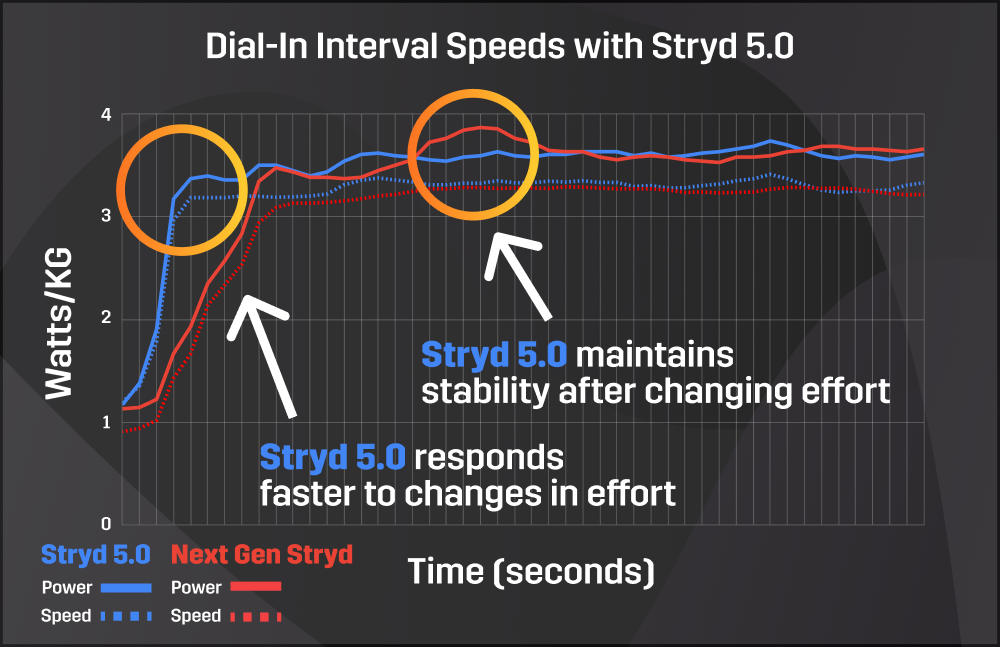
We can see this play out during one of our athlete’s workout reps in the graph above. The blue 5.0 trace reaches target output sooner and shows a clearer step when they change gears, while the red Next Gen trace ramps more slowly before eventually settling.
In your own workouts, that feels like:
- Snappier starts – Cleaner execution from the first strides of an effort instead of spending the opening stretch ramping up or down.
- Precisely paced short bursts – Short accelerations, pick-ups, and strides actually hit the effort you intend, instead of the trace still ramping when you’re already easing off.
- Defined gear changes – Smoother transitions when you surge, float, or settle, with each shift showing up as a clear step in effort rather than a smeared ramp.
- Less chasing the watch – Readings stabilize quickly after each change, so you adjust once and then get back to running.
Quickly Hit Targets on Inclines and Hill Repeats
On steep roads and rolling terrain, it’s not just how hard you push that changes—it’s the ground under your feet. Stryd Next Gen already did a much better job than GPS or heart rate at capturing that, but the effort on screen could still trail behind when the slope shifted. With Stryd 5.0, your power and pace react in step with the grade, so what you see matches how the hill actually feels in your legs.
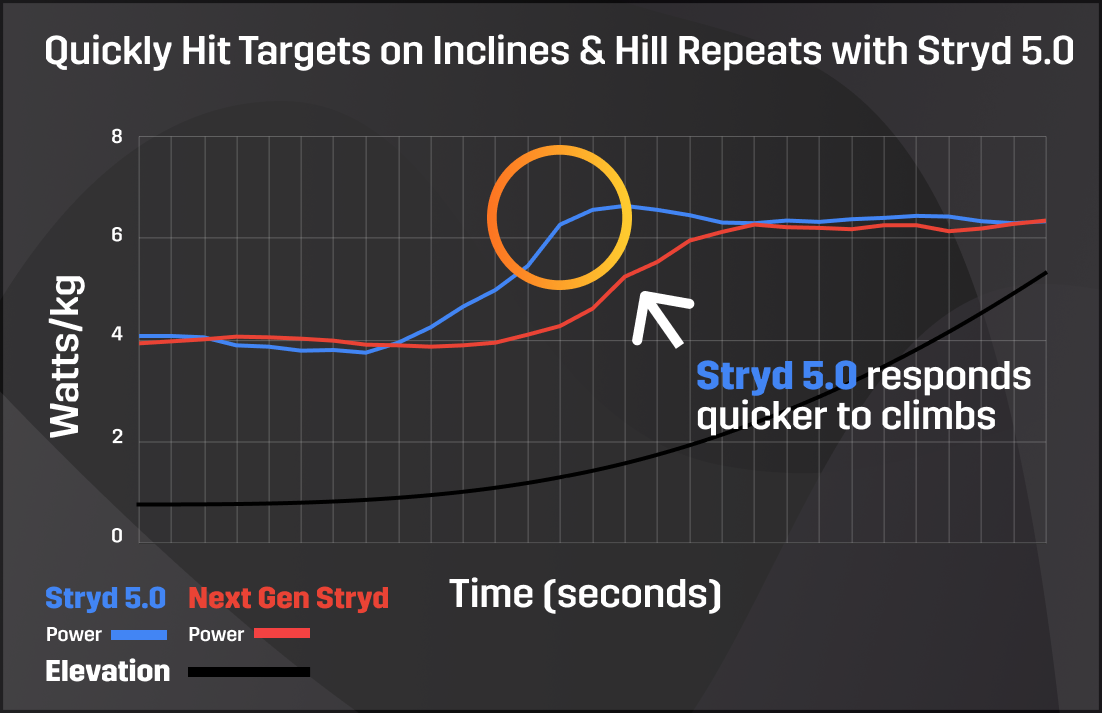
On the flat, the change comes from you—surging, relaxing, and shifting gears. On hills, the terrain is what’s changing under you while you try to stay smooth. In the hill rep above, the athlete tries to hold a steady pace as the road tilts up. The blue Stryd 5.0 trace reacts to the rising grade sooner and with more definition, while the red Stryd Next Gen trace ramps more slowly and smooths over parts of the climb because it’s late to respond.
On hills, that feels like:
- More controlled entries – Effort spikes show up as soon as the grade kicks up, so you can lock on to your target immediately instead of attacking the base too hard.
- More repeatable reps – Each rep climbs to a similar effort and shape, making it easier to stack comparable hills in one session and track progress over time.
- Smoother crests and descents – As you roll over the top or into a downhill, your pacing readout updates quickly, so you don’t adjust your rhythm just to chase a delayed pace number.
Tackle Hikes and Steep Grades with Confidence
Steep terrain isn’t just for mountain trails. Hillside neighborhoods, punchy bike paths, and stair-heavy city routes can all push grades into double digits—places where GPS often struggles and “pace” alone stops telling the full story. Stryd Next Gen already gave you a big advantage by measuring power and pace from your foot, but on very steep grades and slower, hiking-like cadences, the data could still get noisy or feel a step behind your actual effort.
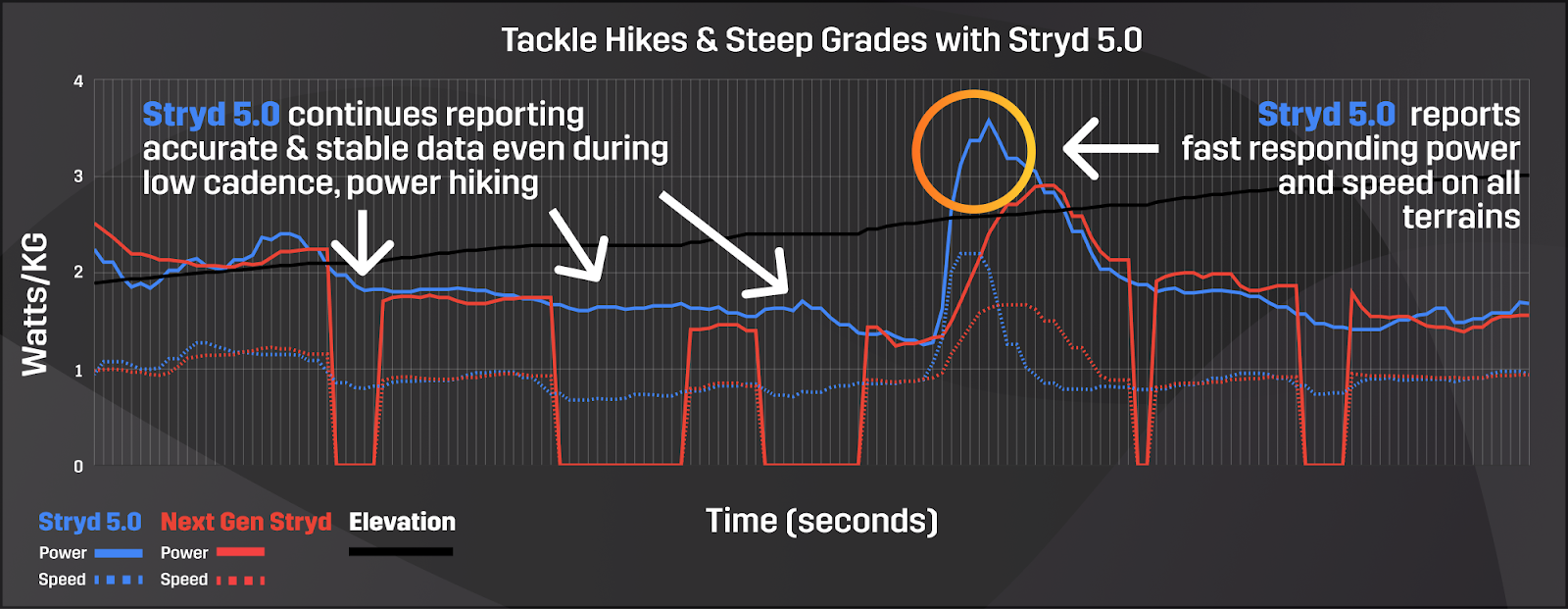
Stryd 5.0 tightens that experience, tuning the pod specifically for the hardest parts of the route—where accurate, responsive data is hardest to get and matters most. In the steep climb above, the blue 5.0 trace stays continuous and detailed as the athlete slows into and out of a hike, while the red Next Gen trace drops out and smooths over sections of the climb.
On hikes, stairs, and steep grinds, that feels like:
- Reliable hiking data – Pace, distance, and power stay continuous even when you slow to short, steep steps.
- Steep effort clarity – On very steep pitches, pacing matches how hard it actually feels.
- Comparable vert training – Steep ascents look similar from session to session, making real gains in uphill power easier to spot.
Consistency on Trails and in Variable Conditions
Most runs aren’t on a flat, calm road. You’re dealing with rolling terrain, changing surfaces, gusts of wind, tight turns, and little surges to pass people or clear obstacles—especially on undulating trails. Stryd Next Gen already handled this mix better than wrist-based GPS, but when several things changed at once, the signal could lose stability and drift from what the effort actually felt like in the moment.
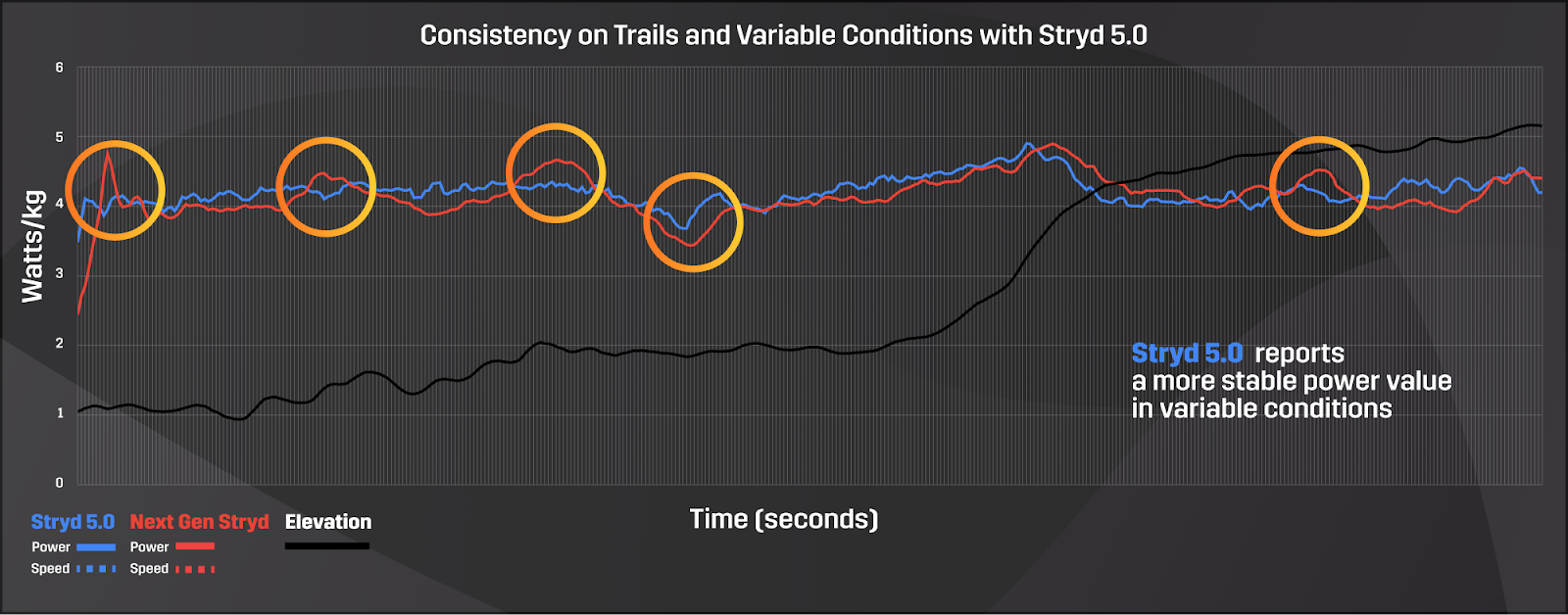
Stryd 5.0 is built for exactly that kind of complexity. In the run above, on a rolling trail with shifting surfaces, wind, and grade changes, the Stryd 5.0 trace stays steadier and more coherent, while the Stryd Next Gen line deviates more in places and shows less stability as conditions stack on top of each other.
On mixed-condition days, that feels like:
- Steady effort in messy environments – As grade, wind, and footing change, your pacing stays tied to your true effort—letting you watch the trail, not your watch.
- Easy runs that stay easy – On rolling, windy, or uneven routes, relaxed days stay truly easy because your effort signal doesn’t quietly drift upward without you noticing.
- Comparable runs on different routes – Loops with different wind, surfaces, or rolling profiles still produce effort traces you can line up and compare instead of feeling like unrelated one-offs.
Conclusion
The new Stryd 5.0 takes what Stryd Next Gen already did well—accurate pacing in tough conditions—and makes it quicker to react and clearer to read whenever your effort or environment shifts. You’re still doing the same workouts and chasing the same goals, but with a clearer signal in the moments that matter most.
That adds up to:
- More control in-session – You find and hold the right effort easily in real time, instead of chasing a number or second-guessing how you feel.
- More confidence afterward – The file you review looks like what you remember running, so you can trust it, learn from it, and repeat it.
Upgrading from Stryd Next Gen doesn’t change what you train for—it just makes the workouts you already run easier to pace, easier to repeat, and easier to learn from afterward.