
Clayton Young Runs 1:02:04 at the Great North Run, Setting the Stage for An American Record Attempt in Chicago

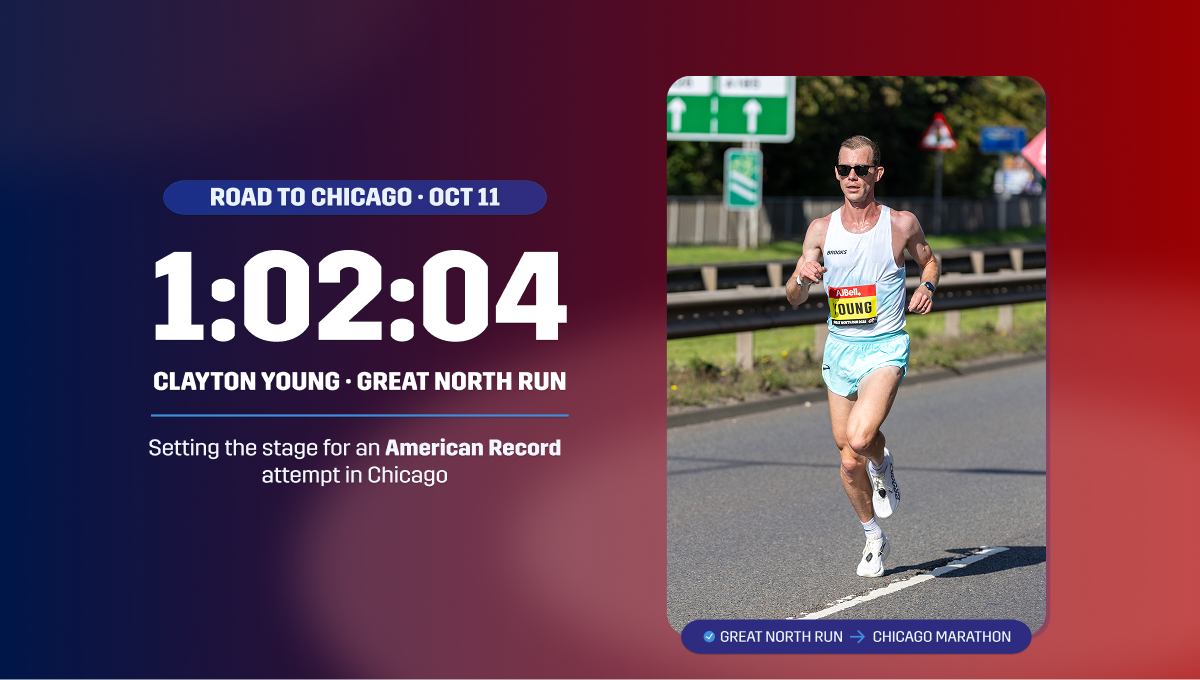
Clayton Young finished seventh at the Great North Run in 1:02:04, racing from Newcastle out to the South Shields seafront.
He arrived in England in the middle of a marathon build, four weeks out from the Chicago Marathon on October 11, carrying 110 to 136 mile weeks in his legs and one of the most ambitious goals in American distance running: a new American record, a target of 2:04:42 or faster.
The finish time in Newcastle tells you where he placed. The power data tells you what kind of shape he brought to the start line, and what it means for Chicago.
Let's dive into the data.
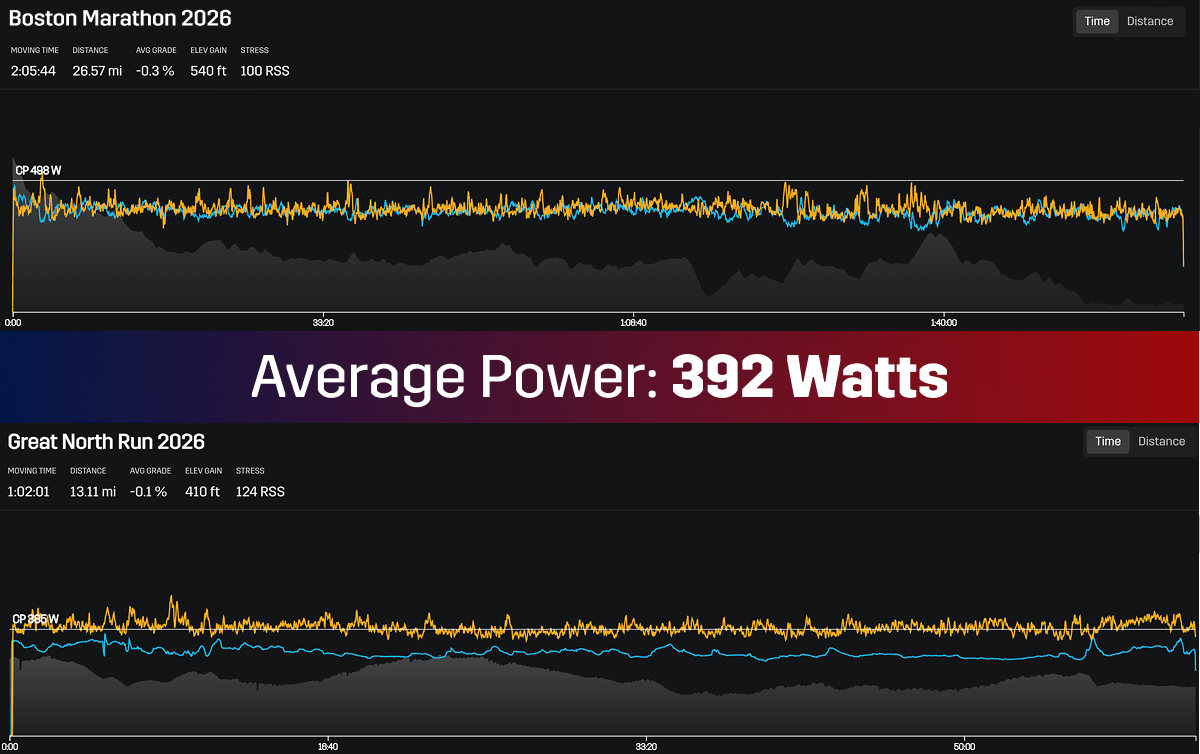
392 Watts: The Same Power He Held for All of Boston
Pace changes with hills, wind, and heat. Power measures how hard the body is actually working, in watts, and that number reflects the effort no matter what the conditions bring.
Young averaged 392 watts at the Great North Run.
He averaged 392 watts for the entire Boston Marathon in April, on his way to 2:05:41.
Identical output, once for an hour and once for over two hours.
The target Stryd has on file for a 2:04:42 in Chicago is 383 watts, nine watts below what he just produced on the roads of South Tyneside and nine watts below what he produced for a full marathon in April.
Chicago asks him for a power number he has already proven he can produce and sustain.

Why a Lower Power Target Produces a Faster Marathon in Chicago
A lower target might sound like a compromise. It isn't. It's a reflection of what a flat course does with every watt a runner outputs.
On rolling terrain, a meaningful share of power goes into overcoming the cost of climbing rather than driving it forward. Newcastle climbed 125 meters and descended 152, and that vertical work is why 392 watts produced a 4:43 pace there. Boston's hills take a similar cut. Chicago takes almost none. The course is famously flat, and nearly every watt goes straight into forward speed.
The reference point is the American record itself, which was run on this course at 4:45 per mile. Young just ran 4:43 per mile for a half marathon on a hillier course, in the middle of heavy training, without a taper. Chicago gives him a flat road, a rested build, and a field that will go out on record pace.
On a flat course, power converts more efficiently into speed, which is why 383 watts in Chicago produces as fast of a pace as the 392 watts in Newcastle.
Holding 385 to 394 Watts Alone Through the Hills of South Tyneside
Young went with the lead pack for the opening four miles, covering 4:20, 4:32, 4:31, and 4:42 as the course dropped through Newcastle and across the Tyne Bridge. At mile five the road climbed, the pack pressed on, and he found himself racing by himself.
What happened over the next seven miles is the most useful stretch of the entire activity.
Running alone into rolling hills and a growing coastal breeze, his power stayed between 377 and 394 watts, close to a flat line for nearly forty minutes. His pace moved with the terrain, from 4:40 on the descents to 5:01 on the climbs, while the effort underneath it stayed locked in.
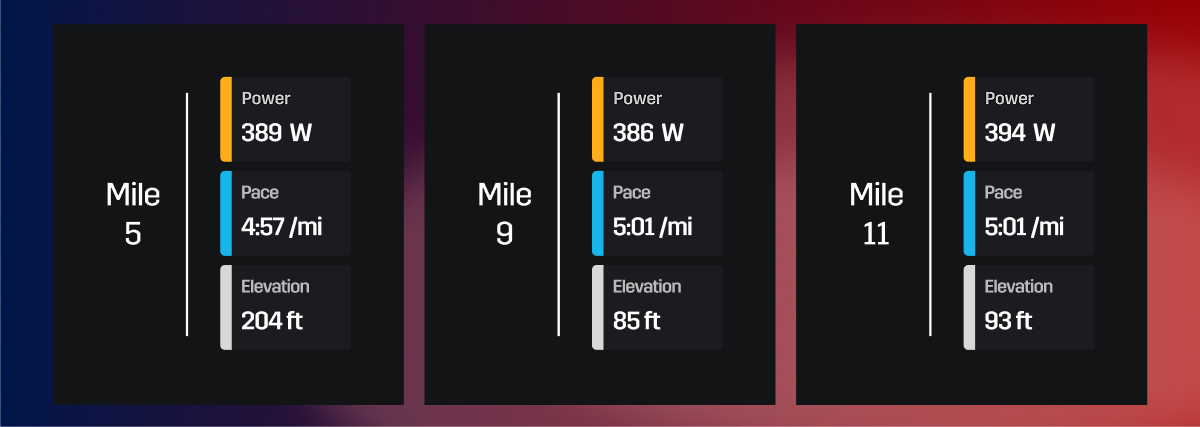
Miles 5, 9, and 11 all go uphill. His power on those miles reads 389, 386, and 394. Mile 11 is the standout: as the road rose, his output went up.
Across the whole race, his second half came through 90 seconds slower on the clock, which looks like a positive split. On the power meter, the difference between his two halves was three watts, which means he paced the race nearly perfectly.
Steady power through adversity is exactly the skill an American Record performance in Chicago will ask for later in the race.
A 428-Watt Sprint With 300 Meters to Go
The closing stretch in South Shields shows what Young had in reserve at the end of an hour of racing.

With 800 meters left, he covered a move at 437 watts. With 400 to go, he covered another at 432 watts, running 4:12 pace. Then, at 300 meters, on the flat seafront with the line in sight, he went: 428 watts, 199 steps per minute, 4:05 pace, with his ground contact time down to 140 milliseconds. That is the sharpest, springiest running of his entire race, produced in the final minute of it.

For comparison, his finishing sprint in Houston in January 2025, on fresh legs at the end of a 1:00:52, measured 429 watts at 198 steps per minute. He brought a comparable closing gear to Newcastle four weeks out from a marathon.
Finding that kind of closing speed at the end of a hard half marathon is an encouraging sign four weeks out, though the marathon will test durability over a much longer distance.
A Summer of Training in Utah That Set Up the Chicago Build
The Great North Run confirmed something that had been building all summer in his training files.
His hard long runs climbed steadily in power from June through September: 307 → 309 → 320 → 321 → 327 watts.
The distances stayed long while the output went up. On August 22 he covered 25.8 miles at 321 watts. On September 5, eight days before Newcastle, he ran 18 miles at 5:25 pace and 327 watts, the strongest quality long run of the entire block.
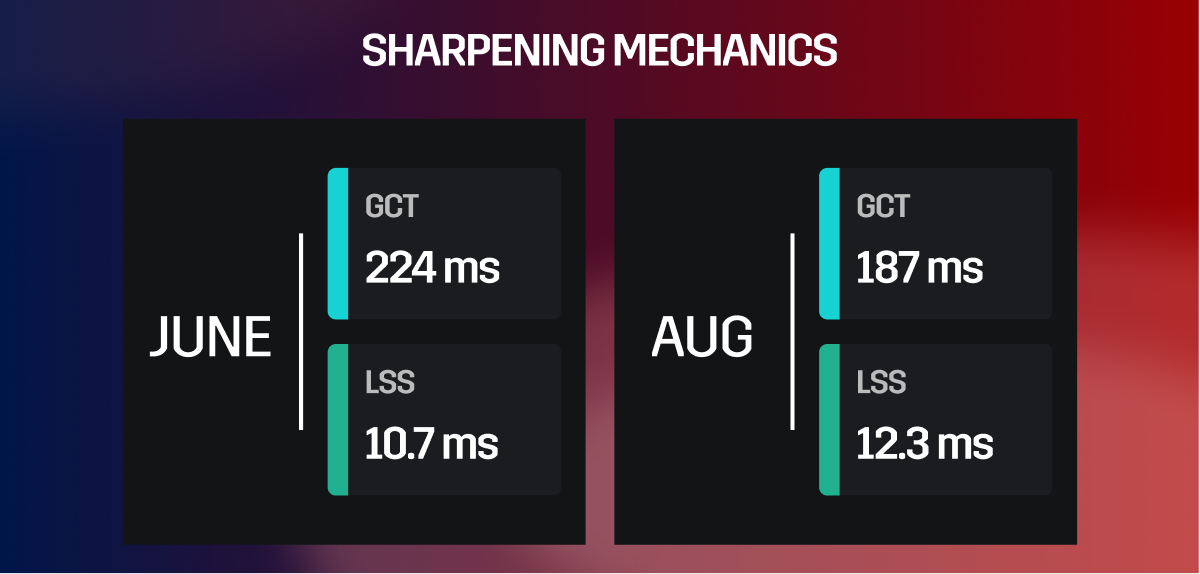
His mechanics sharpened alongside the power. Average ground contact time on those long runs shortened from 224 milliseconds in June to 187 by late August, and his Leg Spring Stiffness, a measure of how much energy his stride returns with each step, rose from 10.7 to 12.3 over the same stretch.
Twelve weeks of rising long-run power across 20 to 25 mile efforts is the clearest evidence in this build that his marathon fitness has improved, and it set up everything he showed in Newcastle.
What the Great North Run Changes for Chicago on October 11
Newcastle gave Stryd's model its first look at a full hour of racing at sea level in this build, and the numbers moved accordingly.

His Critical Power, the output he can hold for an extended effort and a key indicator for Marathon performance, rose from 385 to 397 watts. The duration the model will support at high output jumped from roughly 42 minutes to 67. The predicted range for Chicago now reads 2:03:07 to 2:04:25 at 384 to 388 watts.
His goal has been 2:04:42 or faster. The data has now arrived in the same neighborhood.
The next four weeks will come down to arriving on the Chicago start line rested. The race itself comes down to patience through the opening miles along Columbus Drive and a steady 383 to 388 watts through the later miles, on a flat, record-legal course built for exactly this kind of attempt.
If his power through the later miles in Chicago looks like his power through the hills of South Tyneside, the American Record is live.

The Power of Data-Driven Racing
Clayton Young's Great North Run reinforces three principles that apply to runners at every level:
1. Power grades the effort, the finishing time grades the day. A hillier course in warmer weather produces a slower time at the same workload. Power shows you the workload directly, so you can judge a race accurately the moment you finish it.
2. A tune-up race is there to answer a question. Newcastle asked whether he can hold up at sea level in the middle of a heavy marathon block. The answer came back at 392 watts.
3. Training data is where breakthroughs show up first. Rising long-run power week after week through the summer pointed to this fitness long before race day confirmed it.
Four weeks out from Chicago, on a demanding course and on marathon legs, Clayton Young produced the same power that carried him through Boston in 2:05:41, held it steady through the hills alone, and still had a 428-watt sprint waiting at the end.
On October 11 in Chicago, he gets a flat course, a record-legal one, and 26.2 miles to chase history.